





Introduction
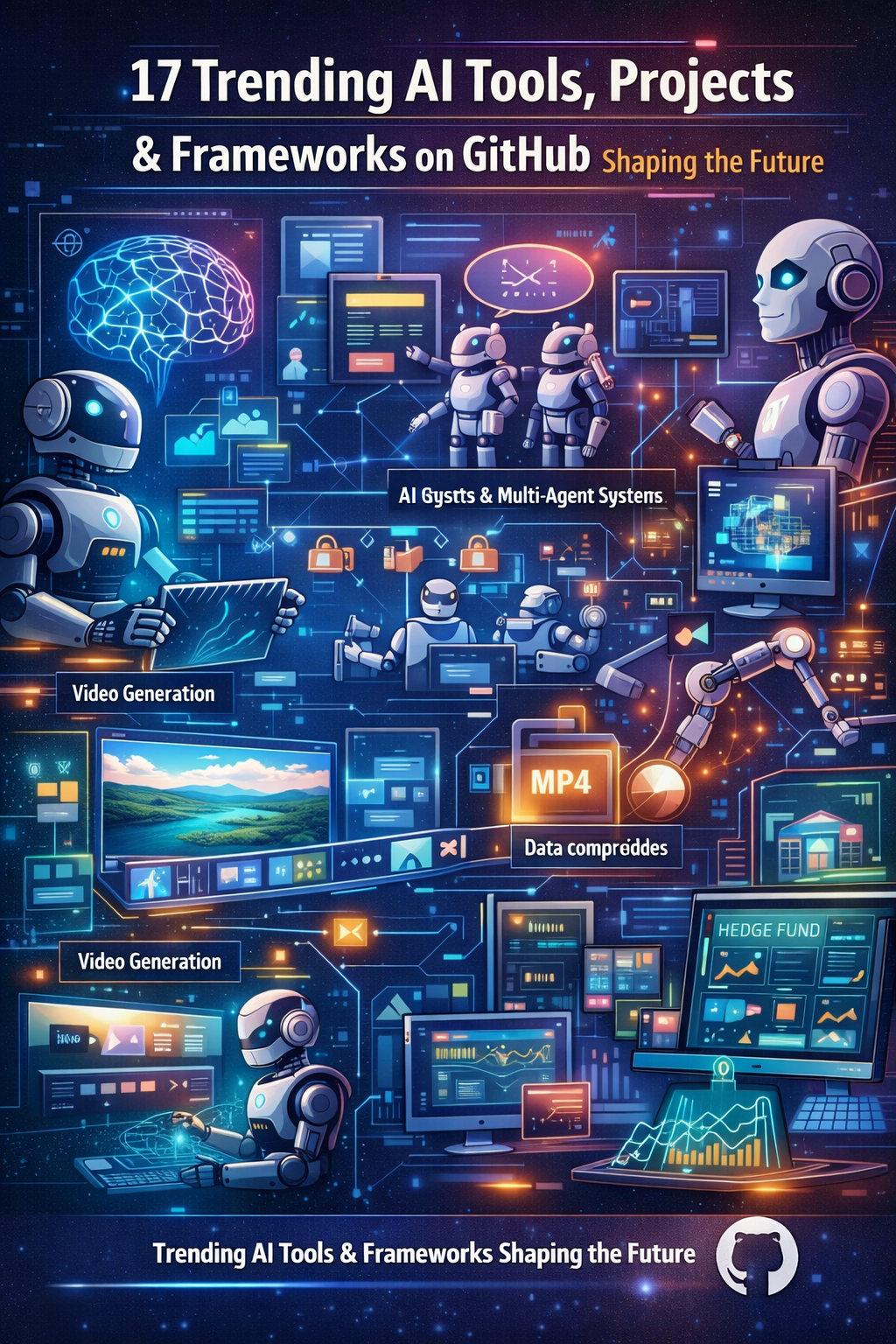
The rapid evolution of artificial intelligence is no longer confined to research labs or corporate roadmaps. Today, some of the most influential AI innovations are emerging directly from open source communities on GitHub. These projects are not experimental side notes. They are actively shaping how large language models, AI agents, video generation systems, robotics and financial simulations will be built and deployed in the years ahead.
A new wave of trending repositories highlights how developers worldwide are redefining what is possible with AI, focusing on scalability, efficiency, collaboration and real-world impact.
Background and Context
Open source has become the backbone of modern AI development. From lightweight language model runtimes to multi-agent orchestration frameworks, GitHub has evolved into a global innovation hub where ideas are tested, refined and adopted at unprecedented speed.
The projects trending in October 2025 reflect key shifts in the AI ecosystem. These include a move toward resource-efficient AI, modular agent design, real-time video intelligence and simulation-driven robotics. Together, they signal a future where AI systems are more autonomous, collaborative and accessible.
Key AI Innovations at a Glance
TL;DR Key Takeaways
- Large Language Models: New approaches focus on efficiency and alternative generation methods, reducing compute overhead while maintaining performance.
- AI Agents: Multi-agent frameworks enable collaboration, planning and adaptive reasoning across complex workflows.
- Memory and Compression: Innovative storage techniques improve long-term reasoning and enable offline AI deployments.
- Video Intelligence: Long-form video generation and real-time stream understanding are advancing rapidly.
- Robotics and Simulation: Hybrid simulation frameworks are accelerating the transition from virtual training to real-world autonomy.
AI Agents and Multi-Agent Collaboration
AI agents capable of reasoning, planning and collaborating are becoming a foundational layer for advanced systems. Frameworks such as MCP Agent and Agent Flow enable developers to design modular, tool-aware agents that can operate together to solve complex tasks.
These platforms emphasize adaptability and orchestration, making them particularly relevant for enterprise automation, research pipelines and autonomous decision-making systems.
Innovations in Memory Systems and Data Compression
As AI systems scale, memory management has become a critical challenge. Projects like Beads introduce structured long-term memory for task tracking and reasoning, enabling models to maintain contextual awareness over extended workflows.
Meanwhile, Mevid presents a novel concept by compressing large text datasets into searchable MP4 files. This approach supports offline AI usage and significantly reduces storage and deployment constraints in low-connectivity environments.
Video Generation and Real-Time Processing
Video-focused AI is undergoing a major transformation. Tools such as Sora Extend allow developers to generate long-form video content by intelligently chaining shorter clips. Diffusion-based video frameworks like RCM push visual fidelity to new levels.
For real-time applications, Streaming VLM introduces efficient continuous video understanding, enabling AI systems to process infinite streams without prohibitive compute costs. These innovations are reshaping media production, surveillance, analytics and interactive content.
Robotics and Simulation Frameworks
Robotics research is increasingly driven by simulation-first development. UNIFM WMA0 exemplifies this trend by combining virtual environments with policy learning, allowing robots to adapt and improve before real-world deployment.
By narrowing the gap between simulation and reality, such frameworks accelerate innovation in autonomous systems, industrial robotics and adaptive machines operating in dynamic environments.
Streamlined API Integration and Spec-Driven Development
Efficient system integration remains a priority for AI teams. Fast API MCP simplifies communication between backend services and AI models using the Model Context Protocol, reducing friction in production deployments.
OpenSpec introduces a spec-driven methodology, encouraging teams to define AI behavior and constraints before implementation. This approach improves collaboration, minimizes rework and aligns AI capabilities with business requirements.
AI in Financial Simulations and Investment Strategies
AI-driven financial modeling is gaining momentum. Projects like AI Hedge Fund simulate autonomous agents capable of analyzing market data, managing portfolios and executing trades.
These simulations offer valuable insights into algorithmic investment strategies and demonstrate how AI can augment decision-making in highly complex and data-intensive financial environments.
Automation and Developer Productivity Tools
Developer-focused AI tools continue to evolve rapidly. Nano Browser streamlines web automation and data extraction, while Superpowers enhances AI coding agents with debugging, collaboration and structured development features.
Together, these tools lower the barrier to entry for building advanced AI systems and significantly boost productivity across development teams.
Expert Commentary
The diversity of these trending projects highlights a clear shift in AI development priorities. Efficiency, modularity and real-world applicability now take precedence over raw model size. Open source communities are leading this transition, proving that meaningful innovation does not always require massive proprietary infrastructure.
Outlook
As these projects mature, their influence is likely to extend beyond GitHub into enterprise platforms, research institutions and consumer-facing applications. The next phase of AI will be defined not just by smarter models, but by smarter systems built on open, collaborative foundations.
The future of AI is already being written in open repositories. The only question is how quickly the rest of the world will adopt what developers are building today.
Sources
- GitHub Trending AI Repositories (October 2025)
https://github.com/trending?since=monthly&spoken_language_code=en - NanoChat – Lightweight LLM Interface
https://github.com/Not-Nano/nanochat - Diffusion-GPT Project
https://github.com/HKUNLP/diffusion-gpt - MCP Agent – Multi-Agent Workflow Framework
https://github.com/modelcontextprotocol/mcp - Agent Flow – Modular AI Planning Framework
https://github.com/agentflow-ai/agentflow - Beads – Long-Term Memory for AI Agents
https://github.com/withbeads/beads