

Introduction
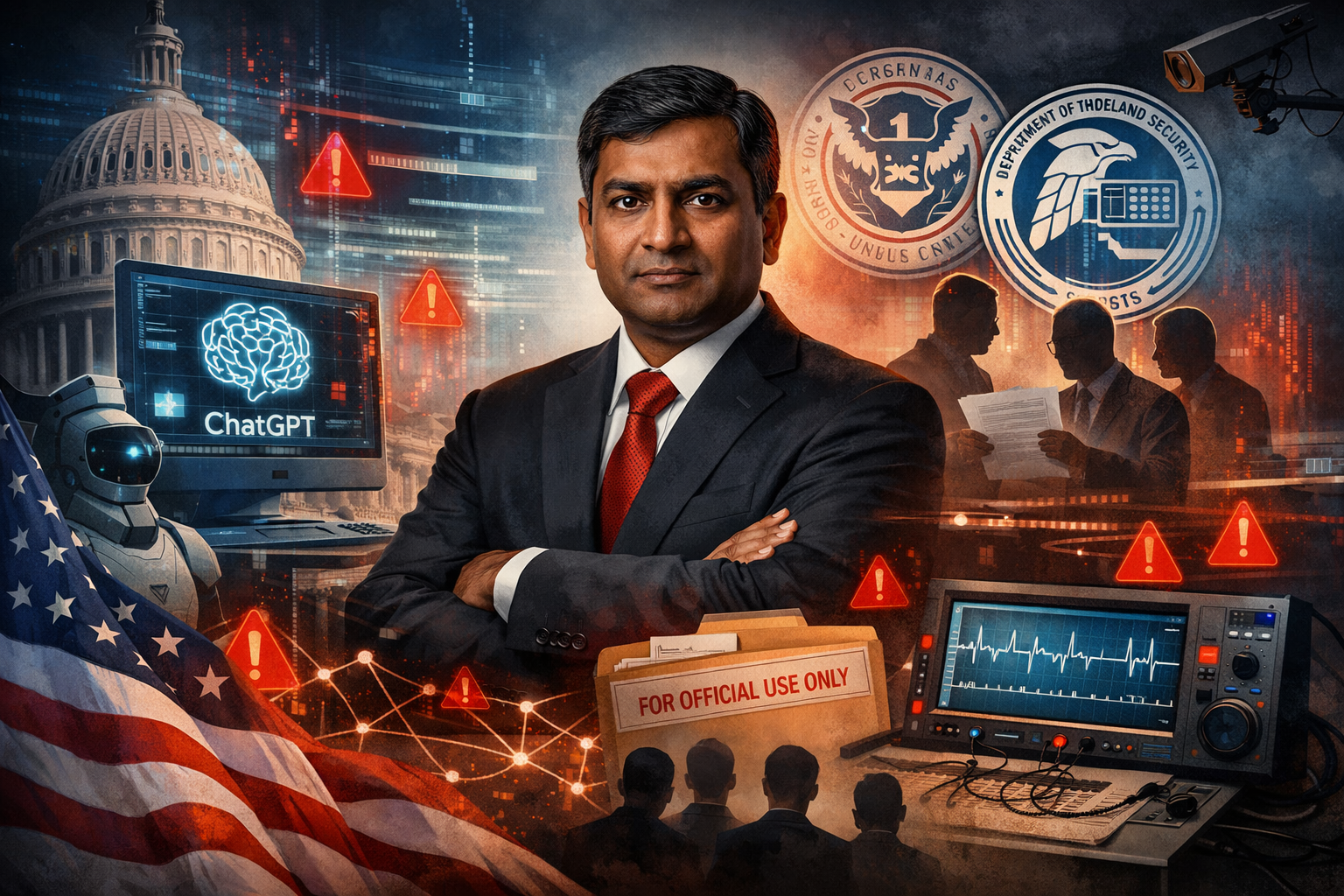
A high-profile security lapse involving the use of generative AI has placed the United States’ top acting cyber official under intense scrutiny. An exclusive report revealed that Madhu Gottumukkala, currently leading the Cybersecurity and Infrastructure Security Agency in an acting capacity, uploaded sensitive government documents into a public version of ChatGPT. The disclosure has triggered internal reviews within the Department of Homeland Security and reignited concerns about AI governance inside federal agencies.
Background and Context
The incident emerged during the summer after automated security systems detected unusual activity linked to AI tool usage. At the center of the controversy is Gottumukkala, the senior-most political official overseeing America’s civilian cyber defense while Senate confirmation for a permanent director remains stalled.
The episode has unfolded against the backdrop of heightened federal pressure to adopt artificial intelligence rapidly, following executive directives from Donald Trump aimed at accelerating US leadership in AI innovation.
Technical Details of the ChatGPT Upload
According to reporting by Politico, Gottumukkala uploaded contracting-related documents marked “for official use only” into a publicly accessible ChatGPT interface last summer.
Key technical and security points include:
- The documents were not classified but were restricted and not intended for public dissemination.
- Uploading them into a public AI system potentially exposed the content to third-party processing by OpenAI.
- Internal cybersecurity sensors within Department of Homeland Security flagged multiple alerts during the first week of August.
- An internal review was initiated to assess potential data exposure and downstream risk.
Internal Review and Official Response
Senior DHS leadership, including legal and information security officials, engaged directly with Gottumukkala as part of the assessment. The review focused on whether the uploads violated internal controls or federal data handling policies.
CISA’s public affairs leadership later stated that Gottumukkala had received limited, short-term authorization to use ChatGPT under DHS controls. The authorization reportedly expired in mid-July 2025. Despite this defense, internal reactions described in the investigation indicated significant concern over judgment and precedent.
The Polygraph Controversy
The ChatGPT episode followed an earlier security-related dispute involving an unsanctioned counterintelligence polygraph exam. Gottumukkala reportedly initiated the test himself and did not pass it, according to officials cited in the report.
The aftermath included:
- Placement of at least six career staff on administrative leave.
- DHS later characterizing the polygraph as unsanctioned.
- Gottumukkala publicly rejecting the characterization during congressional testimony.
The lack of clarity around the purpose and outcome of the exam has continued to raise concerns internally.
Internal Power Struggles at CISA
Further complicating Gottumukkala’s tenure were reports that he attempted to remove CISA’s Chief Information Officer, Robert Costello. The move was blocked by other political appointees, exposing fractures within agency leadership.
Notably, Costello was involved in discussions related to the ChatGPT document review, intensifying scrutiny around internal governance and decision-making.
Profile: A Technocrat With Deep Credentials
Before entering the federal spotlight, Gottumukkala built a lengthy career in state-level technology leadership. He previously served as Commissioner and Chief Information Officer for South Dakota’s Bureau of Information and Technology, and earlier as the state’s Chief Technology Officer.
His academic background includes:
- Bachelor of Engineering in Electronics and Communication Engineering from Andhra University, India
- Master’s in Computer Science from the University of Texas at Arlington
- MBA in Engineering and Technology Management from the University of Dallas
- PhD in Information Systems from Dakota State University
He has also served on advisory committees within academia, contributing to cybersecurity and information systems education.
Impact and Scope
While no classified information was confirmed to be compromised, the incident has broader implications:
- It highlights unresolved risks around AI usage in sensitive government environments.
- It underscores the challenge of balancing innovation with strict data protection requirements.
- It raises questions about leadership judgment at the highest levels of US cyber defense.
Expert Commentary
From a cybersecurity governance perspective, the case underscores a critical insider risk scenario. Even authorized access, when combined with emerging technologies like generative AI, can introduce unanticipated exposure pathways if controls, training, and oversight are not airtight.
The situation also illustrates how AI adoption without mature policy frameworks can undermine trust in institutional security practices.
Outlook
As DHS and CISA continue internal assessments, attention is likely to remain focused on leadership accountability and the development of clearer federal guidelines for generative AI use. With no Senate-confirmed CISA director in place, the agency faces ongoing uncertainty at a time when cyber threats and AI-driven risks are accelerating.
Whether this episode results in policy reform, leadership change, or stricter AI controls remains to be seen, but it is already shaping the national conversation on AI, governance, and cyber responsibility.
Sources
- Madhu Gottumukkala — Wikipedia entry (career summary and background):
https://en.wikipedia.org/wiki/Madhu_Gottumukkala - Trump’s Indian-Origin Cyber Chief Uploaded Sensitive US Government Files to ChatGPT: Report (Open The Magazine):
https://openthemagazine.com/world/trumps-indian-origin-cyber-chief-uploaded-sensitive-us-government-files-to-chatgpt-report - AI use by CISA chief alarms cyber officials (BankInfoSecurity report):
https://www.bankinfosecurity.com/ai-use-by-cisa-chief-alarms-cyber-officials-a-30620