


Introduction
As global governments race to regulate artificial intelligence, South Korea has moved decisively ahead of the pack. On January 22, the country formally enforced the AI Basic Act, positioning itself as the first nation to fully implement a comprehensive, nationwide AI law. Introduced shortly after the European Union’s AI Act in 2024, the legislation is already shaping global conversations on how far regulation should go in balancing innovation, safety, and civil rights.
Background and Context
South Korea’s AI Basic Act was first submitted to parliament in 2020, long before generative AI tools became mainstream. After years of debate and revisions, the law has now come into force, with the government describing it as both a regulatory framework and an industrial policy aimed at accelerating domestic AI development.
While policymakers have highlighted its ambition and global leadership, the Act has drawn criticism from both ends of the spectrum. Technology startups argue it is burdensome and uneven, while civil society groups say it does not go far enough to protect citizens from AI-driven harm.
Key Provisions of the AI Basic Act
Mandatory Labeling and Watermarking
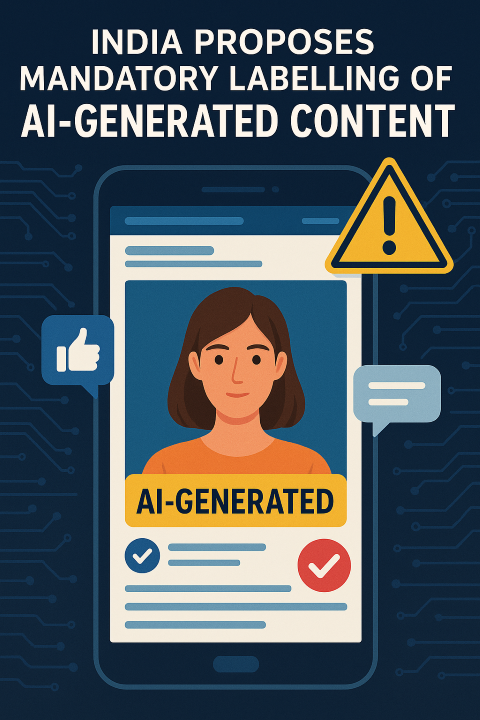
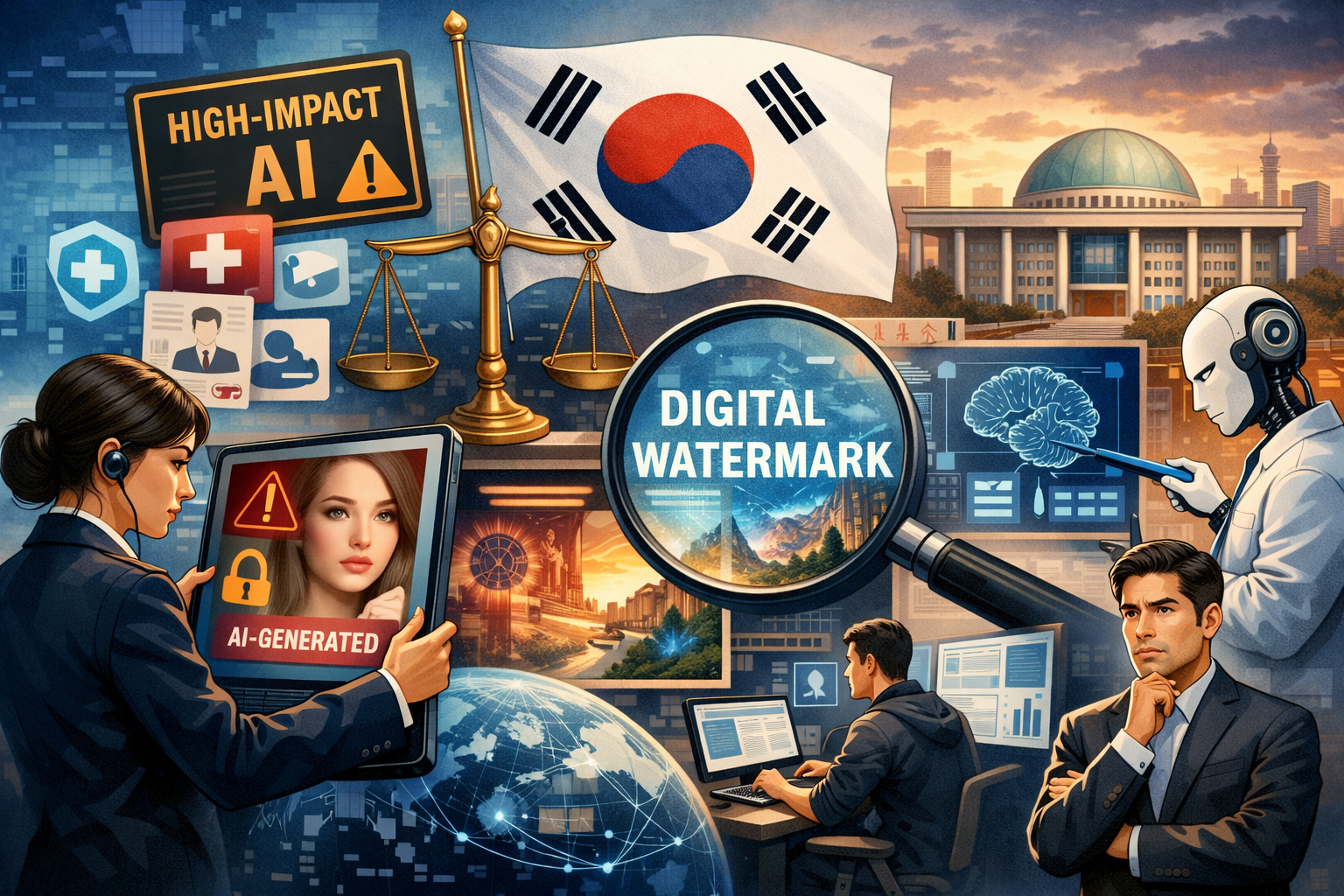
Companies operating in South Korea must apply invisible digital watermarks to AI-generated content, including illustrations, cartoons, and artwork. In addition, realistic deepfakes must carry clear, visible labels indicating that the content was created using artificial intelligence.
Regulation of “High-Impact AI”
The law introduces oversight for so-called high-impact AI systems, such as those used in:
- Medical diagnosis
- Recruitment and hiring
- Credit scoring and loan approvals
Operators of these systems must be able to conduct risk assessments and explain how automated decisions are made. However, if a final decision is taken by a human, the system may fall outside the scope of enforcement.
Penalties and Grace Period
Non-compliant companies face fines of up to 30 million won. To ease the transition, the government has granted a grace period of at least one year before penalties are imposed.
Government Position and Industry Goals
According to South Korean officials, the AI Basic Act is designed primarily to promote the AI industry rather than restrict it. The standards set by the law are intentionally high, with authorities acknowledging that, at present, no existing AI models fully meet all requirements. The intention, they say, is to future-proof the ecosystem rather than stifle innovation.
The Ministry overseeing the rollout, Ministry of Science and ICT, has stated that the law will help reduce legal uncertainty and foster a “healthy and safe domestic AI ecosystem.”
Why AI Startups Are Pushing Back
South Korea’s startup community has emerged as one of the strongest critics of the Act.
Compliance Uncertainty
Companies must first determine whether their systems qualify as high-impact AI, a process that is both time-consuming and legally ambiguous. Many founders fear misclassification could expose them to regulatory risk.
Uneven Playing Field
Local firms argue that the law places heavier compliance obligations on South Korean companies than on foreign AI providers. Global players such as Google and OpenAI, which operate from outside the country, are reportedly subject to more relaxed thresholds.
Industry Readiness
A December survey by Startup Alliance found that 98 percent of South Korean AI startups were unprepared for compliance. Lim Jung-Wook, the organization’s co-head, summarized the mood bluntly: there is growing resentment over being the first country forced to comply with such sweeping AI rules.
Academic voices have echoed this sentiment. Alice Oh, a computer science professor at Korea Advanced Institute of Science and Technology, acknowledged that while the law is imperfect, its goal was to encourage responsible AI adoption without completely suppressing innovation.
Civil Society Concerns and Human Rights Risks
Civil society organizations argue that the AI Basic Act does not adequately protect individuals affected by AI systems.
According to Security Hero, a US-based identity protection firm, approximately 53 percent of global deepfake pornography victims are from South Korea. In 2024, investigators uncovered extensive Telegram networks dedicated to producing and sharing AI-generated sexual images of women and minors, intensifying calls for stricter safeguards.
Human rights lawyers and advocacy groups have criticized the law for focusing on institutional “users” such as hospitals, financial firms, and public agencies, while failing to address the rights of individuals harmed by AI outputs.
South Korea’s national human rights commission has also warned that vague definitions, particularly around high-impact AI, could leave vulnerable groups exposed to rights violations in regulatory blind spots.
Outlook
South Korea’s AI Basic Act is already being watched closely by policymakers worldwide. As the first fully enforced AI law, it represents both a bold regulatory experiment and a potential blueprint for future legislation elsewhere.
Whether the Act ultimately succeeds will depend on how regulators address industry concerns, close human rights gaps, and adapt the framework as AI technology evolves. What is clear is that South Korea has placed itself at the center of the global AI governance debate, setting precedents that others may soon follow.
Sources
- The Guardian
South Korea becomes first country to enforce comprehensive AI law
https://www.theguardian.com/world/2025/jan/23/south-korea-ai-basic-act-world-first-enforced-law - Reuters
South Korea passes sweeping AI law amid deepfake and safety concerns
https://www.reuters.com/world/asia-pacific/south-korea-passes-ai-basic-law-deepfakes-2025-01-22/ - Ministry of Science and ICT, South Korea (Official Announcement)
Overview of the AI Basic Act and policy objectives
https://www.msit.go.kr/eng/bbs/view.do?sCode=eng&mId=4&mPid=2&pageIndex=1&bbsSeqNo=42 - European Commission
The EU Artificial Intelligence Act explained
https://digital-strategy.ec.europa.eu/en/policies/european-approach-artificial-intelligence - Startup Alliance Korea
Survey on AI startup readiness for AI Basic Act compliance
https://startupalliance.kr/insights/ai-regulation-survey-2024 - Korea Advanced Institute of Science and Technology (KAIST)
Expert commentary on AI governance and regulation
https://www.kaist.ac.kr/en/html/research/0213.html