






Introduction
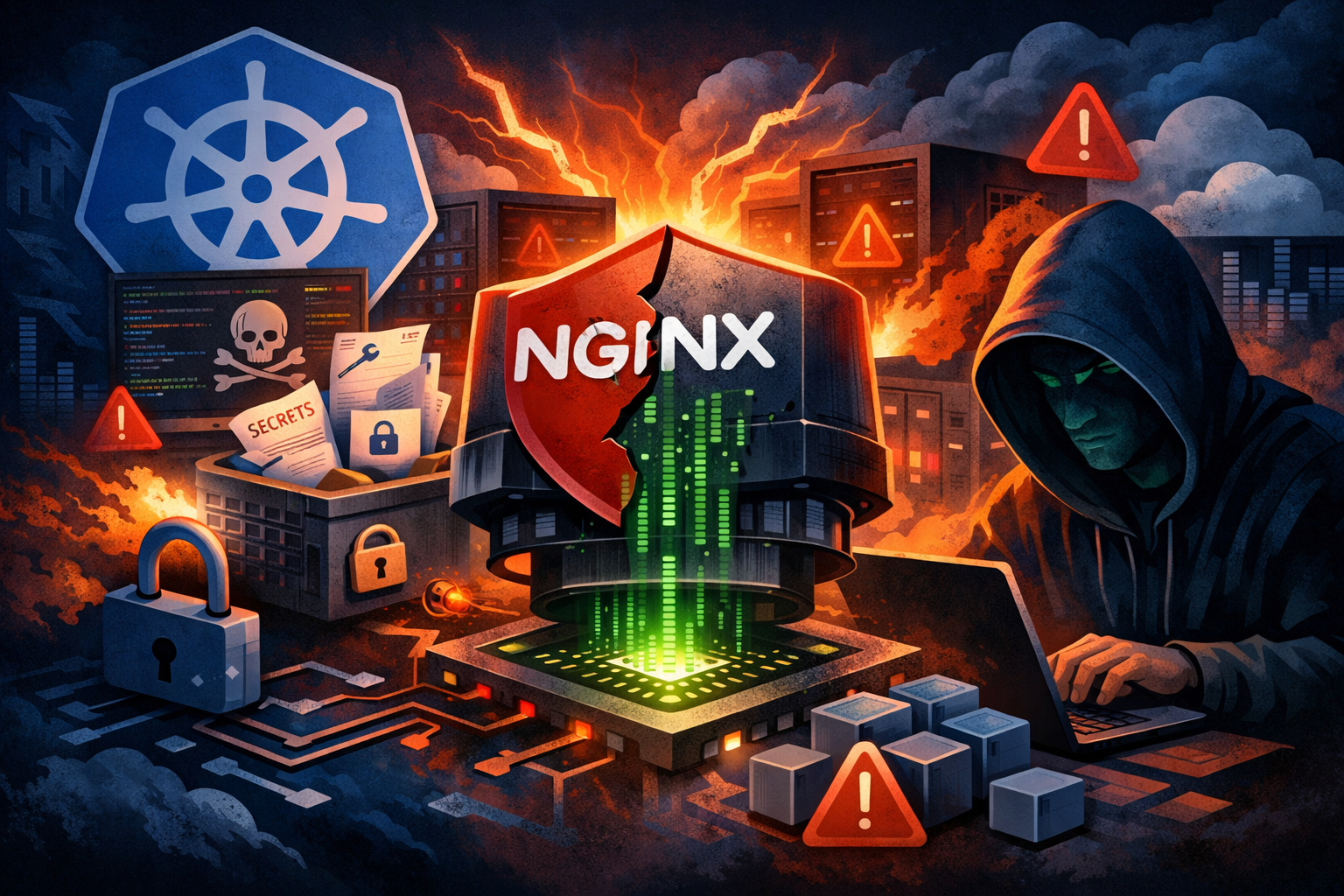
A newly disclosed security flaw in ingress-nginx, one of the most widely deployed Kubernetes ingress controllers, has raised serious concerns across the cloud native ecosystem. The vulnerability could allow authenticated attackers to execute arbitrary code and access sensitive Kubernetes Secrets, potentially leading to full cluster compromise in misconfigured environments.
Tracked as CVE-2026-24512, the issue underscores the risks associated with highly privileged components operating at the edge of Kubernetes clusters.
Background and Context
Ingress controllers act as the primary gateway into Kubernetes clusters, managing external traffic and routing requests to internal services. Among them, ingress-nginx is commonly deployed and, in many default configurations, operates with elevated privileges.
In several environments, the ingress-nginx controller is permitted to read Secrets across all namespaces. As a result, any vulnerability enabling code execution within the controller significantly amplifies risk, expanding the blast radius far beyond a single workload or namespace.
Technical Details
CVE-2026-24512 is a configuration injection vulnerability rooted in improper validation of the rules.http.paths.path field within Kubernetes Ingress resources.
Attackers with permission to create or modify Ingress objects can inject specially crafted values into this field. These values are then incorporated directly into the nginx configuration generated by ingress-nginx, violating the assumption that Ingress definitions are safely translated into server directives.
By exploiting this behavior, an attacker can inject arbitrary nginx directives, ultimately achieving remote code execution inside the ingress-nginx controller pod.
Attack Conditions and Impact
While exploitation requires authentication, the necessary privileges are relatively low. Any user or service account with access to manage Ingress resources could potentially abuse the flaw.
Key characteristics of the vulnerability include:
- Remote exploitability over the network
- Low attack complexity
- No user interaction required
Beyond code execution, successful exploitation enables unauthorized access to Kubernetes Secrets that the controller can read. In default deployments, this often includes Secrets spanning the entire cluster, exposing credentials, tokens, and configuration data used by multiple applications.
Affected Versions
The vulnerability impacts multiple releases of ingress-nginx:
| Product | Affected Versions | Fixed Versions |
|---|---|---|
| ingress-nginx | All versions earlier than v1.13.7 | v1.13.7 |
| ingress-nginx | All versions earlier than v1.14.3 | v1.14.3 |
All later releases also include the fix.
At the time of disclosure, there is no confirmed evidence of active exploitation in the wild.
Response and Mitigation
The Kubernetes security community strongly recommends immediate remediation. Primary and secondary mitigation steps include:
- Upgrade ingress-nginx to v1.13.7, v1.14.3, or later to fully address the vulnerability.
- Deploy a validating admission controller to reject Ingress resources using the
ImplementationSpecificpath type if upgrades must be delayed. - Restrict permissions to create or modify Ingress resources and tighten ingress-nginx RBAC access to only required namespaces and Secrets.
- Monitor Kubernetes audit logs and ingress-nginx configuration changes for suspicious or malformed path values.
- Apply network policies and namespace isolation to reduce blast radius.
- Use runtime security monitoring to detect unexpected process execution or file access within ingress-nginx controller pods.
- Retain audit data and regularly test incident response playbooks that include ingress and controller compromise scenarios.
Administrators can verify deployed versions using: kubectl get pods –all-namespaces –selector app.kubernetes.io/name=ingress-nginx
Strategic Considerations
According to advisories from the Kubernetes security response community, maintenance of ingress-nginx is expected to wind down in the future. This makes long-term migration to alternative ingress solutions a strategic consideration for organizations prioritizing resilience and security.
Outlook
CVE-2026-24512 highlights the disproportionate risk posed by vulnerabilities in highly privileged Kubernetes components. While timely patching is essential, this incident reinforces the importance of defense-in-depth practices, including least-privilege access, strict validation controls, continuous monitoring, and tested response procedures.
Strengthening ingress security as part of a broader zero-trust strategy remains critical for maintaining robust Kubernetes environments over time.