


Introduction
In a stark reminder of the fragility of digital trust, a colossal trove of stolen login credentials has been found openly accessible on the internet. The exposed dataset contains 149.4 million unique usernames and passwords, left completely unencrypted and viewable without authentication, representing one of the most dangerous credential exposures recorded in recent years.
Background and Discovery
The exposure was identified by cybersecurity researcher Jeremiah Fowler, who uncovered an unsecured database totaling nearly 96 GB of raw data. Anyone with a standard web browser could freely browse, search, and download the contents, placing millions of individuals and organizations at immediate risk.
Scope of the Exposed Data
The dataset spans consumer platforms, financial services, and even government-related domains, highlighting the indiscriminate nature of the compromise. Affected services include:
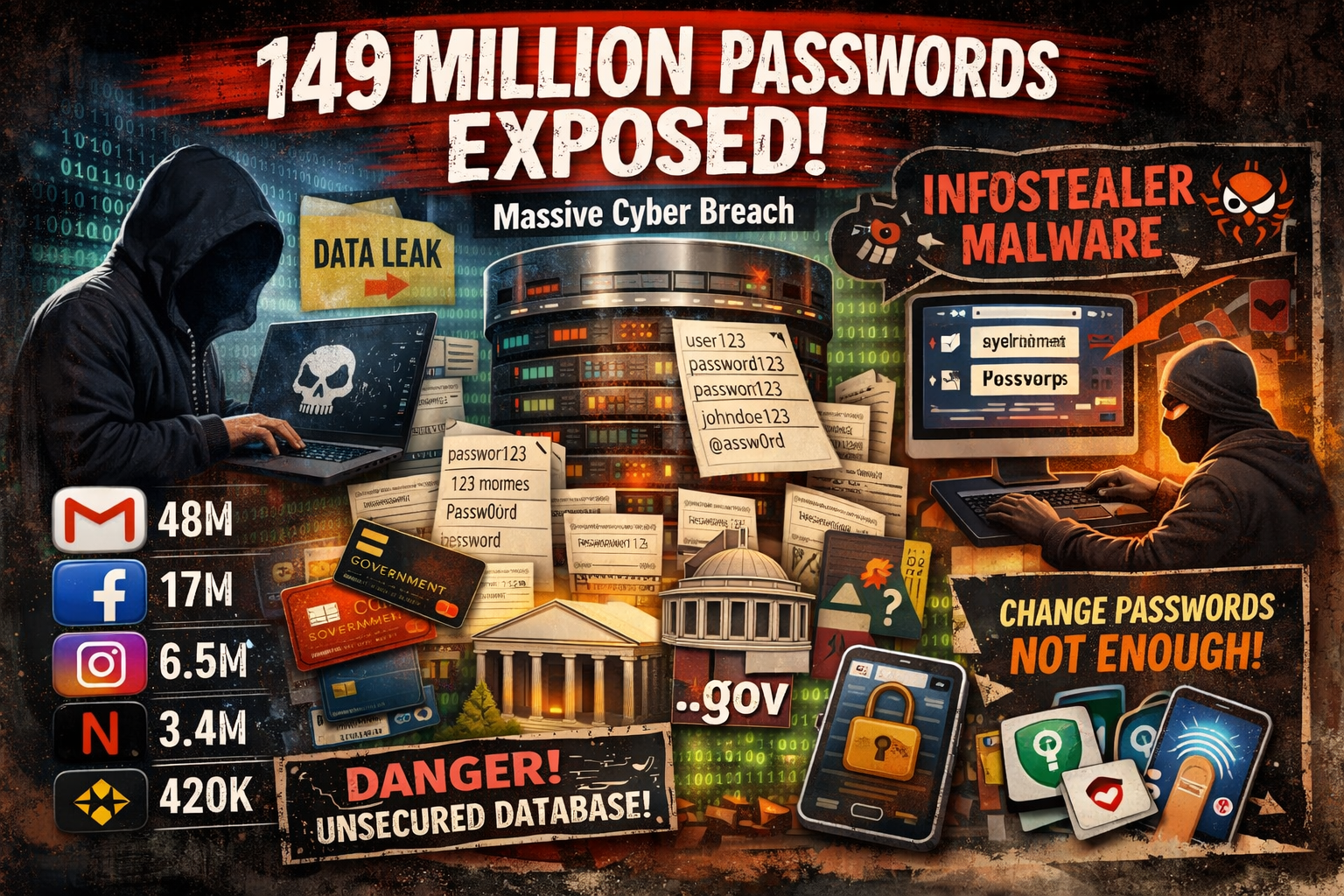
- 48 million accounts linked to Gmail
- 17 million credentials from Facebook
- 6.5 million logins tied to Instagram
- 3.4 million profiles associated with Netflix
- Over 420,000 credentials connected to Binance
Beyond consumer platforms, the database also contained banking credentials, crypto wallet access data, credit card details, and login information linked to multiple .gov domains across different countries. This raises serious concerns around national security, targeted espionage, and high-impact spear-phishing operations.
Technical Analysis: The Role of Infostealer Malware
Security analysts assess that the data was aggregated using infostealer malware, a rapidly growing threat class. Infostealers typically infect systems through phishing emails, malicious advertisements, cracked software, or compromised browser extensions. Once installed, they silently record keystrokes, browser data, and saved credentials, exfiltrating the information to attacker-controlled infrastructure.
A particularly alarming finding was that the database continued to update in real time while efforts were underway to have it removed. This strongly suggests that active infections were still harvesting and uploading fresh victim data throughout the disclosure window, which reportedly lasted nearly a month before the hosting provider disabled access.
Why Changing Passwords Alone Is Not Enough
Unlike breaches caused by compromised servers, this incident stems from endpoint-level infections. As a result, simply resetting passwords does not neutralize the threat. If infostealer malware remains present on a device, any newly entered credentials are immediately captured and leaked again.
This characteristic makes infostealer-driven breaches especially persistent and difficult to contain.
Impact and Risk Assessment
The exposure creates a multi-layered risk landscape:
- Account takeovers across email, social media, and financial platforms
- Identity theft and long-term fraud
- Corporate and government network compromise
- Credential reuse attacks exploiting password recycling habits
The presence of government-linked logins significantly escalates the potential for intelligence gathering and targeted cyber operations.
Response and Mitigation Guidance
Cybersecurity experts strongly recommend the following actions for potentially affected users:
- Conduct full system scans using reputable and updated antivirus or endpoint detection tools
- Remove any detected malware before changing passwords
- Enable multi-factor authentication on all critical accounts
- Monitor financial statements and account activity for suspicious behavior
- Avoid browser extensions and software from unverified sources
Expert Commentary
This incident underscores a critical shift in cybercrime economics. Attackers are increasingly bypassing hardened enterprise infrastructure and instead exploiting end users at scale. Infostealer malware turns everyday devices into credential harvesting tools, creating a continuous pipeline of fresh data for underground markets.
Outlook
As infostealer campaigns become more automated and widespread, large-scale credential leaks are likely to grow both in frequency and impact. Organizations and individuals alike must treat endpoint security, identity protection, and authentication hygiene as foundational components of digital safety rather than optional safeguards.
Sources
- Website Planet
149 Million Credentials Exposed in Unsecured Database
https://www.websiteplanet.com/news/149m-passwords-exposed/ - Security Affairs
Unsecured database exposed 149 million passwords linked to major platforms
https://securityaffairs.com/157873/data-breach/149-million-passwords-exposed.html - HackRead
149 Million Gmail, Facebook, Instagram Passwords Exposed Online
https://www.hackread.com/149-million-gmail-facebook-instagram-passwords-exposed/ - BleepingComputer
Infostealer malware behind massive credential leaks
https://www.bleepingcomputer.com/news/security/infostealer-malware-continues-to-fuel-massive-credential-leaks/ - The Hacker News
Infostealer malware campaigns driving large-scale credential exposure
https://thehackernews.com/2024/infostealer-malware-credentials-leak.html