





Introduction
Can artificial intelligence reason, argue, and judge complex decisions the way a courtroom does? A recent study and real-world system built by Falconer suggests that the answer may be closer than we think.
Falconer is tackling a problem many teams quietly struggle with: documentation rot. As code evolves, documentation often lags behind, turning once-trustworthy knowledge into a risk. Their solution does not just search for information using AI. It focuses on something harder and more important: trust in accuracy.
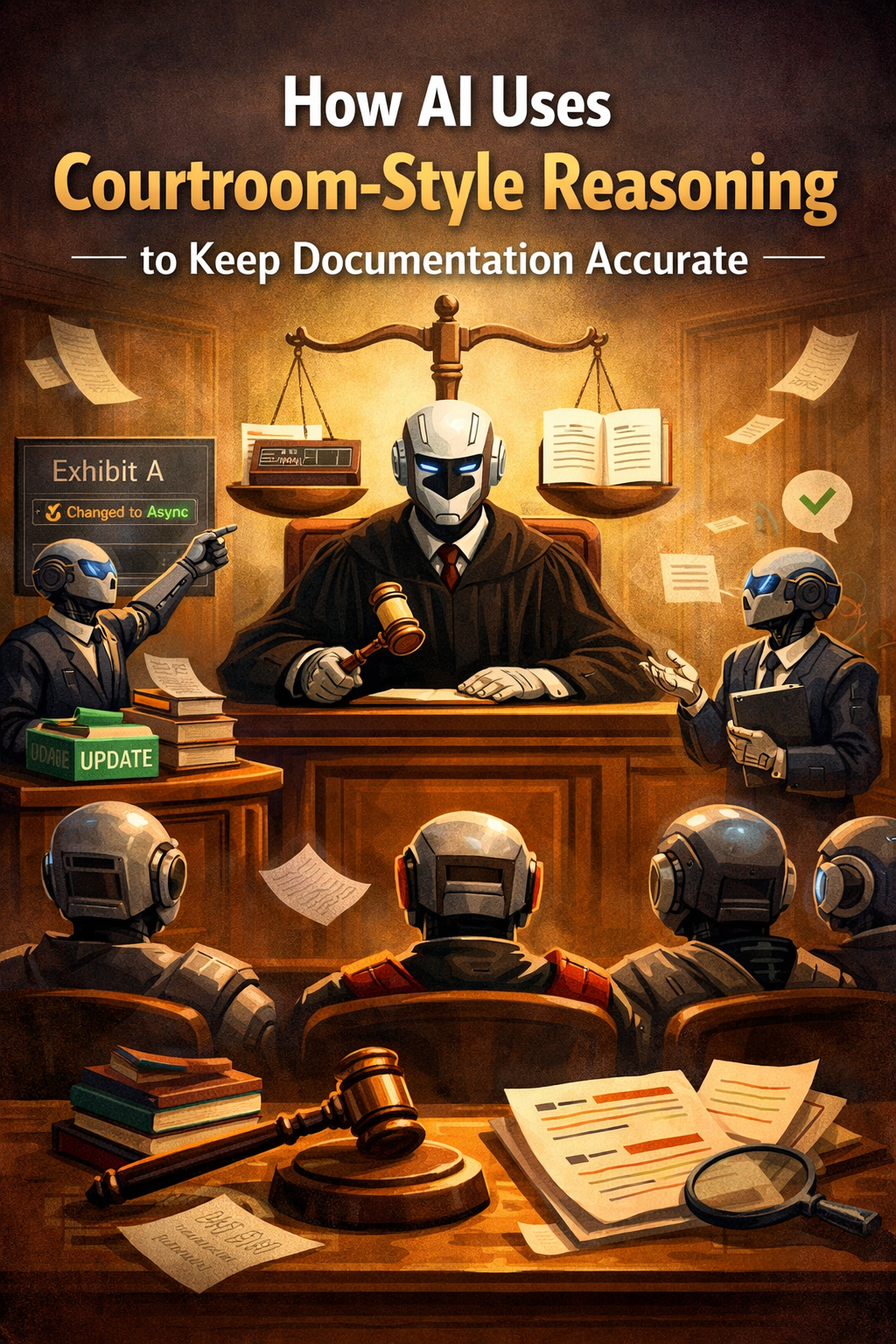
To solve this, Falconer designed an unconventional system inspired by one of society’s oldest decision-making frameworks, the courtroom.
Background: The Problem of Documentation Rot
Modern engineering teams ship code at high speed. Pull requests merge constantly, but documentation rarely keeps pace. Over time, outdated docs mislead developers, support teams, and customers.
AI search tools improve findability, but findable does not always mean correct. An outdated document, even if surfaced instantly, can still cause harm. Falconer identified that the real challenge is not locating knowledge, but deciding whether that knowledge can be trusted after change.
The Core Idea: AI as a Courtroom
Instead of asking an AI model to score relevance on numeric scales, Falconer reframed the problem.
Rather than asking, “How relevant is this document?”, they asked, “Does this document need to be updated, and can you prove it?”
This shift led to the creation of what Falconer calls an LLM-as-a-Courtroom system. The design mirrors legal proceedings, using structured argumentation instead of abstract scoring.
Technical Overview: How the AI Courtroom Works
1. The Prosecutor
The prosecutor agent analyzes merged pull requests and searches for potentially impacted documents. It must build a clear case by providing:
- Exact quotes from the code changes
- Exact quotes from the documentation
- A concrete explanation of harm if the document is left unchanged
If any of these are missing or vague, the evidence is rejected.
2. The Defense
The defense agent challenges the prosecution’s claims. It questions whether the change truly affects the document, whether the harm is overstated, or whether the documentation is already correct.
This adversarial step is critical to prevent false positives and overcorrections.
3. The Jury
A pool of independent AI agents acts as jurors. Each juror reviews the full case in isolation, explains its reasoning, and votes guilty, not guilty, or abstain.
Cases only proceed if a majority agrees that an update is necessary.
4. The Judge
The judge agent delivers the final verdict. It weighs all arguments, jury votes, and evidence before deciding whether documentation should be updated. If guilty, it proposes a small, focused set of edits to avoid overwhelming human reviewers.
Why Legal Reasoning Works for AI
Large language models are especially strong at structured argumentation, explanation, and rebuttal. Legal language activates these strengths because models have been exposed to vast amounts of legal texts during training.
Courtroom-style reasoning forces models to show their logic, address counterarguments, and ground decisions in evidence. This makes outcomes more explainable and auditable than simple numeric scores.
Real-World Results
After running this system in production for three months, Falconer reported:
- 65 percent of pull requests filtered before review
- 95 percent of flagged pull requests dismissed before reaching the courtroom stage
- 63 percent of courtroom cases dismissed without documentation updates
- 83 percent accuracy when cases were escalated to humans
The system is intentionally strict. Falconer prioritizes precision over recall, believing false positives damage trust more than missed updates.
Limitations and Ongoing Research
The team acknowledges challenges such as jury bias and probabilistic outcomes. Multiple AI agents can still converge on the same flawed conclusion. Testing such systems is also difficult, as there is often no single “correct” answer.
Falconer is actively researching better observability, bias detection, and expanded courtroom roles, including appeals and domain-specific courts
Outlook
While AI is not replacing human courtrooms, this research shows that courtroom-inspired reasoning can be an effective framework for complex technical judgment. By borrowing centuries of legal structure, Falconer demonstrates how AI systems can make better, more trustworthy decisions at scale.
This approach may extend far beyond documentation, into policy review, compliance, and other high-stakes decision domains.
Credits and Further Reading
This post is based on an original technical blog written by Aryaman Agrawal, Founding AI Engineer at Falconer. Full credit goes to the original author for the concepts, architecture, and insights described here.
For a deeper and more technical breakdown, readers are strongly encouraged to read the original Falconer blog post for in-depth analysis and diagrams.