






Introduction
India has formally outlined its national vision for responsible artificial intelligence. With the release of the India AI Governance Guidelines, a comprehensive framework designed to promote innovation while mitigating societal, economic, and security risks. Issued under the leadership of the Ministry of Electronics and Information Technology, the guidelines position India as a pro-innovation yet risk-aware jurisdiction in the global AI governance landscape.
For India, a nation balancing scale, diversity, and developmental urgency, AI is not merely a technological upgrade but a strategic lever for national transformation. The guidelines positions AI as both an opportunity and a risk. On one hand, it can accelerate India’s journey toward inclusive growth, digital public goods, and global competitiveness. On the other, unchecked AI can amplify misinformation, bias, systemic vulnerabilities, and national security threats. The Guidelines respond to this duality by proposing a pragmatic, principle-based, and future-ready governance framework.
Background and Context
AI’s rapid evolution has outpaced traditional regulatory models worldwide. India’s approach differs markedly from prescriptive, technology-specific regulation seen in some jurisdictions. Instead, the Guidelines emphasize governing AI applications and outcomes rather than the underlying technology itself. This reflects lessons learned from India’s success with Digital Public Infrastructure such as Aadhaar, UPI, and DigiLocker, where scale, interoperability, and trust were prioritized over rigid controls.
The Guidelines are closely aligned with national objectives, including the vision of Viksit Bharat by 2047 and the principle of AI for All. They recognize that India’s demographic scale, linguistic diversity, and uneven access to infrastructure demand a governance model that is inclusive, adaptive, and innovation-oriented rather than compliance-heavy.
Overview of the India AI Governance Framework
The Guidelines presents a four-part framework that moves from philosophy to practice.
- Part One establishes seven foundational principles, referred to as sutras, that guide all AI governance decisions.
- Part Two examines key issues and offers recommendations across six pillars spanning enablement, regulation, and oversight.
- Part Three lays out a phased action plan across short, medium, and long-term horizons.
- Part Four provides practical guidance for industry and regulators to operationalize safe and responsible AI.
This layered structure ensures coherence between values, policy instruments, institutional mechanisms, and real-world implementation.
Core Philosophy: Seven Foundational Principles
At the heart of the framework are seven guiding principles, referred to as sutras, that shape India’s AI governance approach:
- Trust as the foundation: Trust is identified as the cornerstone of AI adoption and innovation. Without public confidence in AI systems, their developers, and the institutions overseeing them, AI’s benefits cannot be realized at scale. Trust must extend across the entire value chain, from data and models to deployment and use.
- People-first: Human-centric design is non-negotiable. AI systems should empower individuals rather than replace human judgment entirely. The Guidelines emphasize human oversight, human-in-the-loop mechanisms, and capacity building to ensure that people remain in control of AI-driven decisions.
- Innovation over restraint: India explicitly prioritizes responsible innovation over precautionary paralysis. While risks must be mitigated, governance should not stifle experimentation or entrepreneurship. This principle reflects India’s developmental priorities and its ambition to become a global AI hub.
- Fairness and equity: AI systems must not reinforce existing social inequalities. The Guidelines stress inclusive development, bias mitigation, and the protection of marginalized communities. Fairness is framed not only as a technical challenge but as a social and ethical imperative.
- Accountability: Clear allocation of responsibility across the AI value chain is essential. Developers, deployers, and users must be accountable in proportion to their roles, the risks involved, and the diligence exercised.
- Understandable-by-design systems: Transparency and explainability are core design requirements, not afterthoughts. Users and regulators should understand how AI systems function, what data they use, and how decisions are made.
- Safety, resilience, and environmental sustainability: AI systems should be robust against failures, misuse, and systemic shocks. Environmental sustainability is also emphasized, with encouragement for resource-efficient models and responsible compute usage.
These principles are intended to be sector-agnostic and technology-neutral, enabling flexible application across industries.
Key Issues and Recommendations: The Six Pillars
1. AI Infrastructure Enablement
Access to data and compute is central to AI innovation and safety. The Guidelines highlight India’s investments in GPU infrastructure, national data platforms such as AIKosh, and the development of sovereign foundation models. These initiatives aim to democratize AI capabilities beyond a handful of global players. The report underscores that infrastructure is also a risk mitigation tool. Without representative datasets and adequate compute, developers cannot test for bias, robustness, or safety at scale. Integrating AI with Digital Public Infrastructure is presented as a uniquely Indian solution to achieve affordability, scalability, and inclusion.
2. Capacity Building
A recurring theme is the need to empower people rather than merely regulate technology. The Guidelines call for expanded education, skilling, and awareness programs targeting students, professionals, government officials, regulators, law enforcement agencies, and the judiciary. Capacity building is framed as a trust-building exercise. Citizens who understand AI’s capabilities and limitations are better equipped to use it responsibly. Similarly, regulators with technical literacy are better positioned to oversee AI deployments without resorting to blunt regulatory instruments.
3. AI Policy and Regulation
Rather than advocating a standalone AI law, the report argues that many AI-related risks can be addressed through existing legal frameworks, including information technology, data protection, consumer protection, criminal law, and sector-specific regulations. However, the Guidelines acknowledge regulatory gaps. Areas such as platform classification, liability attribution, copyright in AI training, and data protection require targeted amendments and continuous review. The approach is deliberately incremental, allowing the law to evolve alongside technology rather than attempting to future-proof legislation prematurely.
4. Risk Mitigation and AI
Risk mitigation is treated as a dynamic, evidence-based process. The report identifies six broad categories of AI risk: malicious use, bias and discrimination, transparency failures, systemic risks, loss of control, and national security threats. A notable recommendation is the creation of a national AI incident database to collect empirical data on real-world harms. This system would support evidence-driven policymaking, enable early warning mechanisms, and foster a culture of accountability.
The Guidelines also emphasize special protections for vulnerable groups, particularly children and women, who are disproportionately affected by AI-driven harms such as exploitative recommendation systems and non-consensual deepfakes.
5. Accountability Mechanisms
Accountability is operationalized through a mix of legal enforcement, voluntary measures, and market-based incentives. Transparency reports, self-certifications, audits, grievance redressal mechanisms, and peer monitoring are encouraged as practical tools to ensure responsible behavior across the AI ecosystem. The guidelines advocates a graded liability model, where responsibility is proportional to risk and function. This avoids imposing undue burdens on low-risk applications while ensuring that high-risk deployments in sectors such as finance, healthcare, and critical infrastructure face appropriate scrutiny.
6. Institutional Architecture
Recognizing AI’s cross-sectoral nature, the Guidelines propose a whole-of-government approach. At the centre of this architecture is the proposed AI Governance Group, supported by a Technology and Policy Expert Committee. The AI Safety Institute is envisioned as the technical backbone of this system, conducting safety research, developing standards, and supporting regulators with evidence-based guidance. Sectoral regulators retain enforcement authority, ensuring that AI governance remains context-sensitive rather than centralized in a single super-regulator.
Action Plan and Implementation Roadmap
The India AI Governance Guidelines translate policy vision into execution through a clearly sequenced action plan, divided into short-term, medium-term, and long-term horizons. This phased approach reflects an understanding that AI governance cannot be static. It must evolve alongside technological maturity, ecosystem capacity, and empirical evidence of risk.
Short-Term Priorities
In the immediate phase, the focus is on building the institutional and technical foundations of AI governance. This includes the establishment of core governance bodies, such as the AI Governance Group and the operational strengthening of the AI Safety Institute. Early efforts are also directed at developing India-specific AI risk assessment frameworks that reflect local socio-economic realities.
Voluntary commitments from industry form a key pillar in this phase. Rather than imposing immediate compliance burdens, the Guidelines encourage organizations to adopt transparency reporting, grievance redressal mechanisms, and internal risk controls. Parallelly, the government is expected to review existing laws and suggest targeted amendments where regulatory gaps are already evident, particularly around liability and platform classification.
Medium-Term Measures
The medium-term horizon shifts from experimentation to standardization and enforcement readiness. By this stage, the Guidelines envisage the publication of common standards, benchmarks, and technical protocols for issues such as content authentication, cybersecurity, bias testing, and explainability. Legal amendments identified in earlier phases are expected to be enacted, and regulatory sandboxes introduced to allow controlled testing of high-risk or frontier AI applications. These sandboxes provide limited regulatory flexibility while generating evidence on risks, safeguards, and real-world impacts.
Another critical medium-term goal is the operationalization of AI incident reporting systems. By aggregating data across sectors, regulators can identify patterns of harm, emerging threats, and systemic vulnerabilities, allowing governance to shift from reactive enforcement to proactive risk prevention.
Long-Term Vision
In the long term, the framework emphasizes adaptability and sustainability. Governance mechanisms are expected to undergo periodic review to remain aligned with technological advances such as autonomous AI agents, multi-agent systems, and increasingly general-purpose models. Long-term efforts also include sustained international engagement, standard-setting leadership, and continuous capacity building to ensure that India’s AI ecosystem remains competitive, secure, and inclusive.
Content Authentication and the Deepfake Challenge
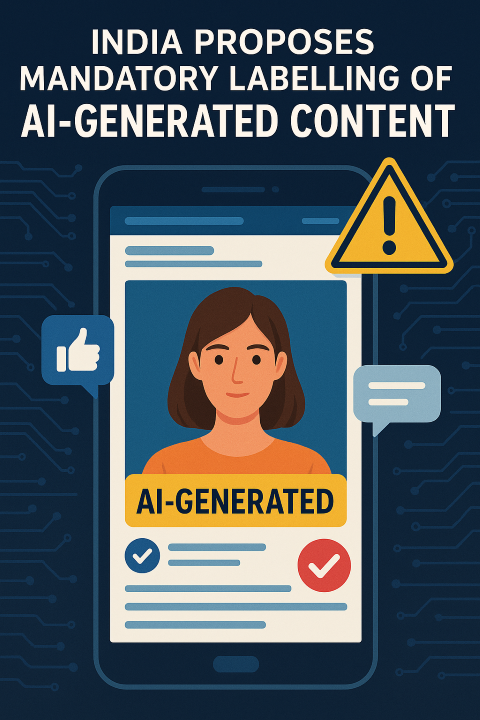
One of the most pressing governance challenges addressed in the Guidelines is the rise of AI-generated deepfakes and synthetic media. The report treats this not merely as a content moderation issue but as a threat to democratic trust, social stability, and individual dignity.
The Guidelines advocate for content authentication and provenance mechanisms that can verify whether digital content has been generated or modified by AI. Industry standards such as cryptographic watermarks, metadata tagging, and provenance frameworks are highlighted as promising tools, while also acknowledging their technical limitations and the risk of circumvention by malicious actors. Rather than mandating a single solution, the guidelines recommends a techno-legal approach, combining standards, voluntary adoption, regulatory oversight, and international coordination. A dedicated expert committee is proposed to develop global standards in this domain, positioning India as an active contributor to the international response to synthetic media threats.
Copyright, Data, and the Economics of AI Training
The question of copyright in AI training emerges as one of the most contested policy areas in the report. The Guidelines recognize the tension between fostering innovation through large-scale data access and protecting the rights of creators and publishers.
Instead of taking a definitive stance, the guidelines documents ongoing deliberations and emphasizes the need for a balanced framework. International approaches such as Text and Data Mining exceptions are examined, with the understanding that any Indian solution must align with domestic legal principles, cultural norms, and economic priorities. This cautious approach reflects a broader governance philosophy: avoid premature regulatory lock-in in areas where global norms are still evolving, while ensuring that stakeholder voices are heard and harms are not ignored.
Accountability Without Overregulation
Accountability is framed as a spectrum rather than a binary. The Guidelines deliberately avoid equating accountability solely with punitive enforcement. Instead, they promote a layered approach combining transparency, self-regulation, market incentives, and legal enforcement when necessary. Grievance redressal mechanisms are emphasized as a frontline accountability tool, ensuring that individuals affected by AI systems have accessible channels to report harm and seek remedies. Over time, insights from these systems are expected to feed into product improvements and regulatory learning.
A graded liability model ensures proportionality, recognizing that AI systems are probabilistic by nature and that not all failures are the result of negligence or malice.
Institutional Oversight
A “whole-of-government” approach underpins enforcement and coordination. The proposed institutional architecture reflects the complexity of AI governance. Rather than centralizing authority in a single regulator, the Guidelines advocate coordination across ministries, sectoral regulators, standards bodies, and advisory institutions. Key proposals include:
- Establishment of an AI Governance Group (AIGG) for cross-ministerial policy alignment
- Creation of a Technology and Policy Expert Committee (TPEC) for technical and legal expertise
- Strengthening the AI Safety Institute (AISI) to conduct safety testing, standards development, and risk research
Sectoral regulators such as RBI, SEBI, TRAI, and others will retain enforcement authority within their domains.
Impact and Scope
The guidelines are expected to directly influence:
- AI developers, deployers, and platform operators
- Startups and MSMEs adopting AI-driven solutions
- Public sector AI procurement and deployments
- Cybersecurity, content moderation, and digital trust mechanisms
By combining voluntary compliance with enforceable legal backstops, India aims to avoid overregulation while ensuring accountability.
Global Leadership and AI Diplomacy
AI governance is explicitly framed as a foreign policy issue. The Guidelines recognize that standards, norms, and governance models developed today will shape global technology flows, security dynamics, and economic competitiveness. India’s active participation in multilateral forums such as the G20, United Nations, and OECD is presented as both a responsibility and an opportunity. By advocating a balanced, pro-innovation, and inclusion-focused model, India positions itself as a bridge between advanced economies and the Global South.
Expert Commentary
From a cybersecurity and governance standpoint, India’s AI framework reflects a pragmatic balance. It avoids premature regulatory rigidity while clearly signalling expectations around transparency, risk mitigation, and accountability. The emphasis on techno-legal solutions, incident reporting, and sectoral enforcement aligns well with evolving AI-driven threat models.
Outlook
As AI capabilities mature, the guidelines are designed to evolve through periodic reviews, foresight exercises, and global engagement. India’s approach may serve as a reference model for other Global South economies seeking inclusive, innovation-friendly AI governance without compromising safety or sovereignty. The India AI Governance Guidelines do not present AI as a problem to be controlled or a miracle to be unleashed without restraint. Instead, they treat it as a powerful societal force that must be shaped through principles, institutions, and continuous learning.
By grounding AI governance in trust, people-first values, and innovation-friendly regulation, India charts a path that is both nationally relevant and globally significant. If implemented effectively, this framework has the potential to become a reference model for responsible AI governance in the 21st century.
Source:
India AI Governance Guidelines: Enabling Safe and Trusted AI Innovation, Government of India