




Introduction
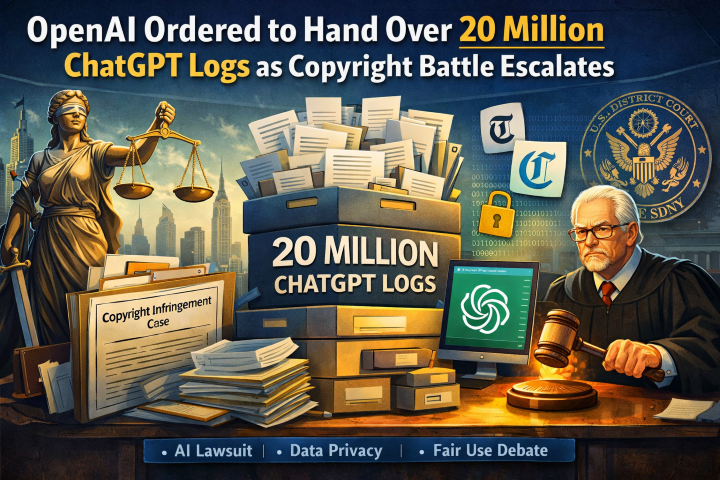
A US federal judge has affirmed an order requiring OpenAI to produce 20 million anonymized ChatGPT conversation logs as part of a sweeping consolidated copyright infringement case brought by major news organizations. The ruling marks a significant development in one of the most closely watched legal battles shaping the future of artificial intelligence and copyright law.
Background and Context
The dispute is part of a multidistrict litigation pending in the United States District Court for the Southern District of New York, where 16 copyright lawsuits against OpenAI have been consolidated. The cases stem from allegations that OpenAI unlawfully used copyrighted news content to train and operate its AI models.
News organizations, including New York Times Co. and Chicago Tribune Co. LLC, argue that access to large-scale ChatGPT output logs is critical to evaluating how copyrighted material may have been reproduced or transformed by the AI system.
Technical and Discovery Details
Originally, the news plaintiffs sought access to a 120 million-log sample of ChatGPT conversations. After negotiations, OpenAI proposed a reduced dataset of 20 million logs, representing approximately 0.5 percent of preserved conversation records. The plaintiffs agreed to this reduced sample in August 2025.
However, OpenAI later declined to produce the full dataset, offering instead to run keyword searches and provide only conversations it deemed relevant to the publishers’ works. The plaintiffs rejected this approach and moved to compel full production of the de-identified logs.
Magistrate Judge Ona T. Wang sided with the publishers, finding that even logs not directly reproducing copyrighted content could be relevant to OpenAI’s fair use defense.
Court Ruling and Judicial Reasoning
The court found that privacy concerns were adequately addressed through multiple safeguards, including:
- Limiting discovery to 20 million logs instead of billions
- Use of OpenAI’s custom de-identification tools
- A protective order governing use of the data
Judge Stein also dismissed OpenAI’s reliance on prior securities law precedent, noting that ChatGPT users voluntarily submitted their conversations and that OpenAI’s lawful possession of the logs was not in dispute.
Importantly, the court ruled that there is no legal requirement obligating judges to select the least burdensome discovery method when relevance and proportionality standards are satisfied.
Impact and Scope
The decision significantly expands the evidentiary record available to plaintiffs and increases legal exposure for OpenAI. It also sets a meaningful benchmark for how courts may balance user privacy against discovery needs in AI-related litigation.
Beyond this case, the ruling is expected to influence future disputes involving generative AI, training data transparency, and the boundaries of fair use.
Outlook
As discovery proceeds, the production of 20 million anonymized ChatGPT logs may shape both settlement dynamics and substantive rulings on copyright liability. With dozens of similar lawsuits pending across the US, this case is widely viewed as a bellwether for the AI industry.
The litigation is formally captioned In re: OpenAI, Inc. Copyright Infringement Litigation, Case No. 1:25-md-03143 (S.D.N.Y.), with the latest order issued on January 5, 2026.