



Introduction
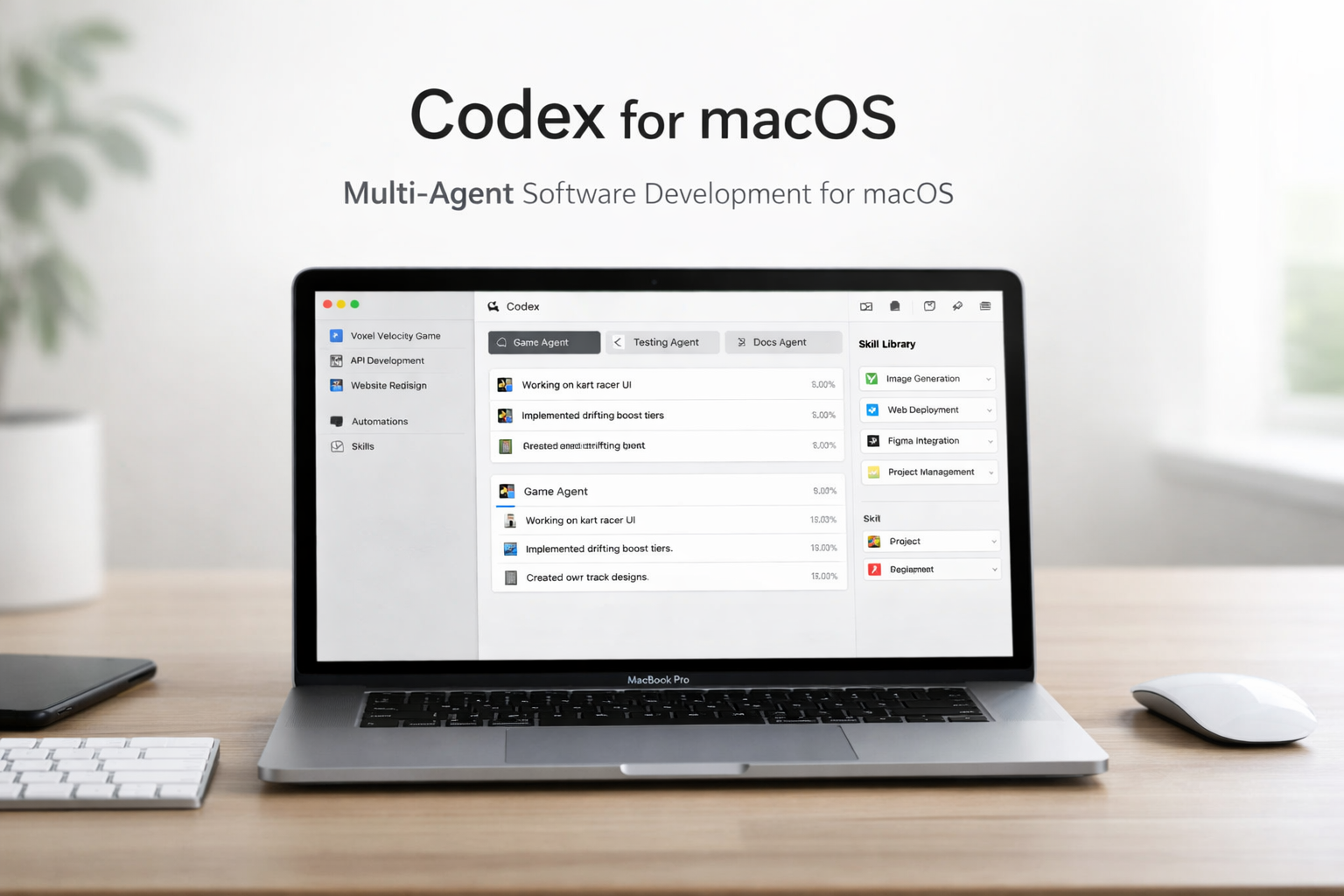
OpenAI has officially introduced the Codex app for macOS, a purpose-built desktop command center designed to manage, supervise, and collaborate with multiple AI agents simultaneously. This release marks a significant evolution in how modern software is designed, built, shipped, and maintained, especially as development workflows increasingly rely on long-running, autonomous agents rather than short, prompt-driven interactions.
Alongside the app launch, OpenAI has expanded Codex availability across ChatGPT plans and temporarily increased rate limits, signaling a strategic push to accelerate real-world adoption of agent-driven development.
Background and Context
Since the launch of Codex in April 2025, AI agents have shifted from simple code generators to capable collaborators that can independently handle complex, multi-day development tasks. Developers are no longer asking whether agents can write code, but how to effectively direct, coordinate, and trust multiple agents working in parallel.
Traditional IDEs and terminal-based workflows were never designed for supervising autonomous agents at scale. The Codex macOS app directly addresses this gap by providing a dedicated interface focused on orchestration, oversight, and collaboration.
The Codex App Explained: A Command Center for Agents
The Codex app introduces a new mental model for development workflows.
Key Capabilities
Multi-agent parallel execution
Each agent runs in its own isolated thread, organized by project. Developers can seamlessly switch between tasks, review progress, and intervene only when necessary.
Integrated code review and control
Agent-generated changes are visible directly in the app. Users can comment on diffs, approve updates, or open changes locally in their editor for manual refinement.
Worktree-based isolation
Built-in Git worktree support allows multiple agents to work on the same repository without conflicts. Each agent operates on its own copy of the codebase, enabling safe experimentation without polluting local Git state.
Seamless ecosystem integration
The app automatically syncs session history and configuration from the Codex CLI and IDE extensions, allowing developers to continue existing projects without friction.
Beyond Code Generation: Skills and Intelligent Automation
Codex is evolving into a general-purpose digital worker through Skills, modular bundles of instructions, scripts, and tool integrations that allow agents to perform structured tasks reliably.
Examples of Skills in Action
- Translating Figma designs into production-ready UI code
- Deploying applications to platforms such as Vercel, Netlify, Cloudflare, and Render
- Managing project workflows in Linear
- Generating and editing images using GPT Image
- Creating and editing PDFs, spreadsheets, and DOCX files
- Referencing up-to-date OpenAI API documentation during builds
These skills can be explicitly invoked by users or automatically selected by Codex based on task requirements. Skills can also be versioned and shared across teams via repositories, ensuring consistency in agent behavior
Real-World Demonstration: Autonomous Game Development
In a notable demonstration, Codex was tasked with building a complete 3D voxel racing game using Three.js. With a single high-level prompt and a curated set of skills, Codex independently assumed the roles of designer, developer, and QA tester.
The project consumed over 7 million tokens, continuously testing and improving the game through iterative self-prompting and validation. This experiment highlights Codex’s potential for handling full-lifecycle projects rather than isolated coding tasks.
Automations: Delegating Repetitive Work
The Codex app introduces Automations, allowing agents to run scheduled background tasks without manual intervention. Automations combine instructions with optional skills and deliver results to a review queue.
OpenAI internally uses Automations for:
- Daily issue triage
- CI failure analysis and summaries
- Release brief generation
- Bug detection and reporting
This capability positions Codex as not just a development assistant, but an operational backbone for engineering teams.
Security and Governance by Design
Security is deeply embedded into the Codex agent stack.
- Native, open-source sandboxing limits file access by default
- Network and elevated commands require explicit approval
- Configurable project-level rules enable trusted automation for specific workflows
This balance of safety and flexibility makes Codex suitable for enterprise environments with strict governance requirements.
Availability and Pricing
- Available now on macOS
- Included with ChatGPT Plus, Pro, Business, Enterprise, and Edu subscriptions
- Temporarily available to ChatGPT Free and Go users
- Rate limits doubled across all paid plans for a limited time
- Additional usage credits available for purchase
Codex works seamlessly across the desktop app, CLI, web, and IDE extensions using a single ChatGPT login.
Competitive Landscape: How Codex Compares
| Feature | Codex App | GitHub Copilot | Cursor | Replit AI |
|---|---|---|---|---|
| Native multi-agent orchestration | Yes | No | Limited | No |
| Long-running autonomous tasks | Yes | Limited | Partial | Partial |
| Worktree-based isolation | Yes | No | No | No |
| Built-in automation scheduling | Yes | No | No | Limited |
| Skills-based extensibility | Yes | No | Partial | Partial |
| Enterprise-grade sandboxing | Yes | Partial | Partial | Partial |
While competitors focus primarily on inline code assistance, Codex differentiates itself as an agent orchestration platform, positioning it closer to an AI-powered development operating system than a traditional coding assistant.
Outlook
With Codex usage doubling since the release of GPT-5.2-Codex and over one million developers engaging with the platform in the past month, OpenAI is clearly betting on agent-first development as the future of software engineering.
Upcoming roadmap highlights include:
- Windows version of the Codex app
- Faster inference and expanded model capabilities
- Cloud-triggered Automations for always-on agent workflows
- Continued refinement of multi-agent supervision and UX
Codex represents a decisive step toward closing the gap between what frontier AI models can do and how effectively humans can apply them in real-world work.
References and Credits
- Official announcement and product details by OpenAI
- Codex documentation and skill libraries available via OpenAI’s official developer resources
For more information, visit OpenAI’s official website and Codex documentation portal.