


Introduction
The year 2025 marked a decisive shift in the global cyber threat landscape for the telecommunications industry. No longer viewed as a passive utility, telecom infrastructure has emerged as a high-value strategic asset, attracting ransomware syndicates, state-sponsored espionage groups, and organized cybercriminal networks.
For India, a country rapidly scaling its digital and connectivity ambitions, the warning signals are unmistakable. Retrospective analysis of 2025 threat data confirms that Indian telecom entities are now direct and deliberate targets, firmly embedded in the global cyber conflict arena.
This report-driven analysis examines the nature of the attacks, the adversaries behind them, and the risks confronting India’s telecom ecosystem as it enters 2026.
Ransomware Escalation: India Enters the Global Target Zone
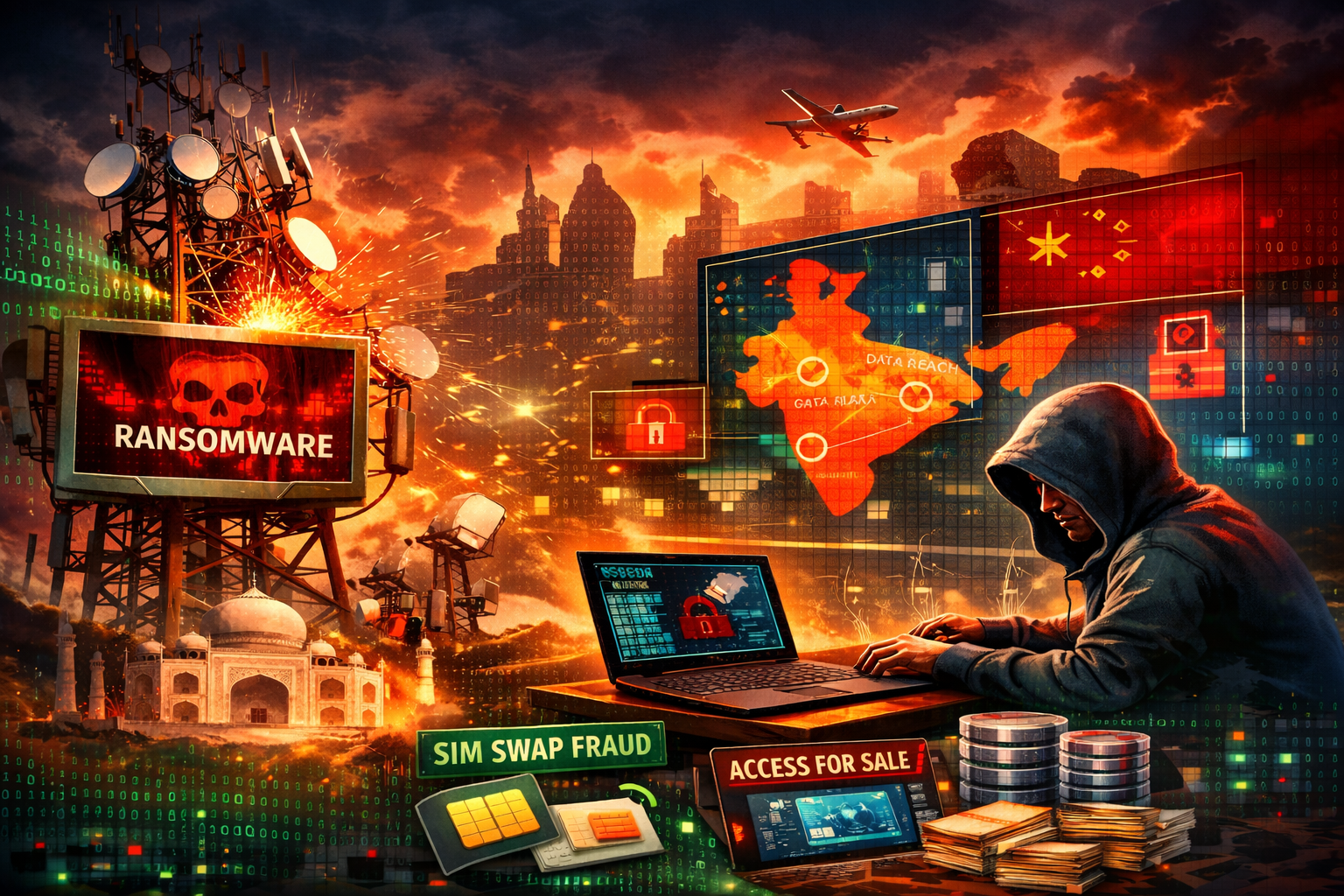
One of the most concerning developments of 2025 was the explosive growth of ransomware activity against telecommunications providers worldwide. Over the past four years, ransomware incidents targeting the sector have increased nearly fourfold.
While the Americas remained the most heavily impacted region, accounting for approximately 70 percent of reported cases, India’s inclusion as a confirmed victim nation represents a critical inflection point. Two verified ransomware incidents involving Indian telecom entities occurred during the year.
This places India alongside advanced economies such as France, Germany, and Italy, all of which experienced comparable attack volumes. In total, the sector endured around 90 large-scale ransomware attacks globally in 2025, underscoring a sustained and systemic threat rather than isolated criminal events.
Threat Actors: Highly Organized and Persistent
A concentrated group of well-organized ransomware operations drove the attack surge, effectively industrializing cybercrime.
Three groups alone accounted for nearly 40 percent of all known telecom-focused ransomware incidents:
- Qilin led activity levels, frequently re-targeting compromised environments and coordinating parallel extortion efforts.
- Akira and Play demonstrated advanced capabilities, extending their reach into technology supply chains, network equipment vendors, and internet infrastructure providers.
For Indian telecom operators, this highlights a critical reality. The threat landscape is dominated by disciplined, financially motivated groups capable of sustaining long-term campaigns rather than single-hit intrusions.
Attack Vectors: Exploitation of Zero-Day and Known Vulnerabilities
A defining characteristic of 2025 attacks was the rapid weaponization of vulnerabilities in internet-facing infrastructure. Threat actors consistently bypassed perimeter defenses by exploiting both Zero-Day and Known Exploited Vulnerabilities in widely deployed enterprise and telecom technologies.
Frequently targeted platforms included:
- Ivanti Connect Secure, where critical flaws such as CVE-2025-0282 were exploited at scale.
- Cisco and Fortinet network-edge devices, leveraged for persistent access and covert surveillance.
- Microsoft and Apple ecosystems, including SharePoint and macOS, used as secondary footholds during lateral movement.
India’s reliance on third-party service dependencies and exposed network gateways significantly expanded the attack surface, creating favorable conditions for exploitation.
State-Sponsored Espionage: The Salt Typhoon Campaign
Beyond financially motivated ransomware, 2025 also saw intensified state-backed espionage operations against the telecom sector. A China-linked threat actor known as Salt Typhoon compromised telecommunications providers across approximately 80 countries, as documented.
Although specific Indian victims were not publicly disclosed, the group’s focus on call data interception, network persistence, and surveillance capabilities presents a substantial national security concern. Such campaigns are designed to remain undetected for extended periods, quietly extracting sensitive communications and metadata.
Cybercrime Economy: Monetizing Telecom Access and Data
The threat landscape also revealed a mature underground economy centered on telecom infrastructure abuse.
Key trends included:
- Sale of initial access to telecom networks, including administrative-level router access, often priced in the thousands of dollars.
- SIM swapping services advertised as a criminal offering, enabling attackers to bypass two-factor authentication and hijack financial accounts.
- Large-scale circulation of stolen subscriber databases containing personally identifiable information, call logs, and national identifiers.
These activities illustrate how telecom breaches extend far beyond operational disruption, directly impacting consumers, financial systems, and national trust.
Impact and Strategic Implications
The inclusion of India among confirmed ransomware victim nations signals a broader shift in adversary focus. Telecom networks are now viewed as gateways to economic leverage, intelligence collection, and mass data exploitation.
The convergence of ransomware, espionage, and underground data markets positions the telecom sector as one of the most strategically contested digital domains heading into 2026.
Response and Mitigation Outlook
To counter this evolving threat environment, Indian telecom providers must prioritize proactive defense strategies, including:
- Accelerated patching of known exploited vulnerabilities
- Continuous monitoring of internet-facing gateways and remote access infrastructure
- Strengthened supply chain risk management
- Enhanced threat intelligence sharing across the sector
Reactive security postures are no longer sufficient. In the current climate, sustained vigilance and anticipatory defense are essential for resilience.
Expert Commentary
According to the Cyble Telecommunications Sector Threat Landscape Report 2025, the convergence of financially motivated and state-sponsored threats represents a long-term structural risk to global connectivity infrastructure.
For India, safeguarding telecom networks is no longer just an operational necessity but a matter of economic stability and national security.
Outlook
As 2026 unfolds, the telecom sector will remain a primary battleground in global cyber conflict. Organizations that fail to adapt risk becoming persistent targets in an increasingly hostile digital environment.
In this new reality, cybersecurity is not a support function. It is the front line.
Source
Cyble Telecommunications Sector Threat Landscape Report 2025, January 2026