



Introduction
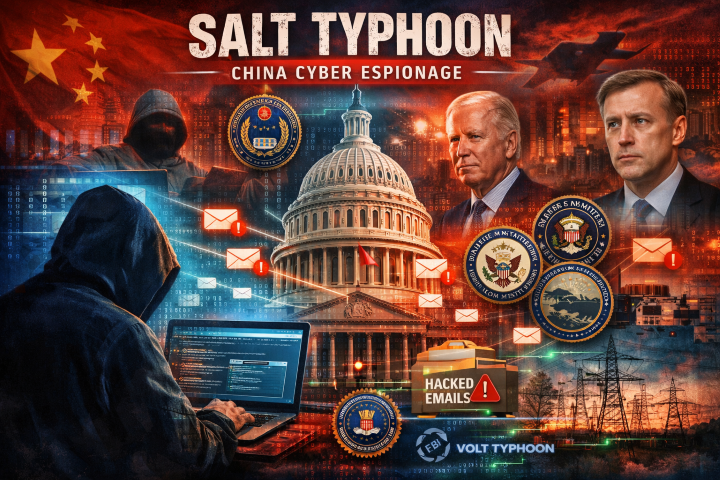
A sophisticated Chinese cyber-espionage campaign known as Salt Typhoon has compromised email systems used by staffers of key United States congressional committees, marking one of the most serious intelligence breaches targeting legislative communications in recent years. US officials describe the operation as part of a sustained effort by Chinese intelligence to infiltrate American political and communications infrastructure.
Background and Context
The breach was discovered in December and is attributed to China’s Ministry of State Security, the country’s primary civilian intelligence service. According to individuals familiar with the investigation, attackers successfully accessed email platforms used by congressional aides working on sensitive national security and foreign policy matters.
While investigators have not confirmed whether the personal email accounts of lawmakers themselves were compromised, the targeting of staff communications raises significant concerns about intelligence collection and legislative security.
Technical Details of the Breach
Chinese intelligence operatives reportedly infiltrated email systems supporting staffers from multiple high-profile committees within the US House of Representatives, including:
- The House Select Committee on China
- The Foreign Affairs Committee
- The Intelligence Committee
- The Armed Services Committee
These committees routinely handle classified or sensitive discussions related to defense policy, intelligence oversight, and US-China relations, making them high-value targets for foreign intelligence services.
Timeline of Events
- Several years prior: Salt Typhoon is believed to have been active, quietly exploiting vulnerabilities in US telecommunications and communications infrastructure.
- December: Intrusions into congressional staff email systems are detected.
- 2024: US agencies publicly acknowledge the broader scope of China’s state-sponsored cyber operations targeting American infrastructure.
About the Threat Actor: Salt Typhoon
Salt Typhoon is assessed to be a long-running cyber-espionage platform operated by the MSS. Security sources indicate the campaign enables access to unencrypted phone calls, text messages, voicemails, and in certain circumstances, email accounts. The operation is also believed to have intercepted communications involving senior US officials over multiple years.
Former national security adviser Jake Sullivan previously warned that US telecommunications providers were “highly vulnerable” to this campaign, underscoring systemic weaknesses exploited by Chinese intelligence.
Related Incidents
Salt Typhoon is part of a broader ecosystem of Chinese state-sponsored cyber operations. In 2024, US authorities revealed that another Chinese-linked hacking group, Volt Typhoon, had penetrated US energy, transportation, and communications networks. Officials warned that such access could be leveraged during a potential geopolitical conflict.
The Federal Bureau of Investigation and other agencies characterized Volt Typhoon as a pre-positioning threat aimed at critical infrastructure disruption.
Impact and Scope
The compromise of congressional staff communications poses risks beyond immediate data exposure. Access to internal discussions, scheduling, policy drafts, and strategic correspondence could provide foreign intelligence with insights into US legislative priorities and decision-making processes.
Even without direct access to lawmakers’ personal accounts, staff-level communications often serve as gateways to broader institutional knowledge.
Response and Mitigation Efforts
US authorities are reportedly working with congressional IT teams and telecommunications providers to assess the full extent of the breach, close exploited vulnerabilities, and strengthen defensive monitoring. However, officials acknowledge that countering well-resourced state-sponsored actors remains a persistent challenge.
Expert Commentary
Cybersecurity experts note that the Salt Typhoon campaign highlights the evolving nature of cyber-espionage, where long-term access and intelligence collection take precedence over disruptive attacks. The incident reinforces the need for end-to-end encryption, zero-trust architectures, and continuous threat hunting across government communications systems.
Outlook
As geopolitical tensions between Washington and Beijing persist, analysts expect Chinese cyber-espionage efforts against US political institutions to continue. The Salt Typhoon breach serves as a stark reminder that legislative bodies are increasingly on the front lines of cyber intelligence warfare, requiring sustained investment in cybersecurity resilience.
References / Source Attribution
- Reporting by the Financial Times
- Statements from US federal law enforcement and national security officials