




Introduction
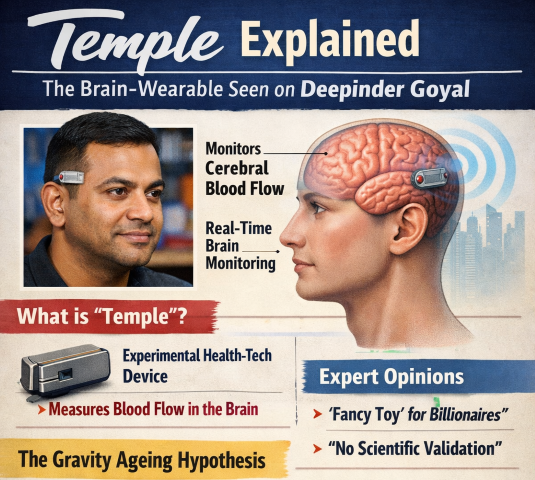
A small metallic device clipped to the side of Deepinder Goyal’s head during a recent podcast appearance has triggered widespread curiosity, memes, and debate across social media. Nicknamed “Temple”, the wearable has been described by Goyal as a real-time brain blood flow monitoring device, raising questions about its purpose, scientific validity, and future potential.
Background and Context
The device gained public attention when the Zomato CEO appeared on Figuring Out, hosted by Raj Shamani. Viewers quickly noticed the silver clip-like object on Goyal’s temple, prompting humorous comparisons ranging from chewing gum to external storage devices.
This was not the first public appearance of Temple. Goyal has previously stated that he has been wearing the device for over a year as part of his personal research into ageing and human biology.
What Is ‘Temple’?
According to Goyal, Temple is an experimental health-tech wearable designed to measure cerebral blood flow in real time. He has compared its intended function to a miniaturised MRI-like capability, claiming it continuously tracks brain blood circulation.
Temple is currently a research prototype being developed under a health-tech startup of the same name, linked to Goyal’s initiative, Continue Research. It is not a Zomato product and is not commercially available.
Research Motivation and the Gravity Ageing Hypothesis
The wearable is closely tied to Goyal’s controversial “Gravity Ageing Hypothesis”, which suggests that gravity-induced reductions in brain blood flow may contribute to ageing. Goyal has announced a $25 million personal investment into research focused on ageing, longevity, and biological health.
According to him, brain blood flow is already recognised as a biomarker associated with cognition, ageing, and longevity. He argues that Temple could remain relevant even if his gravity-related hypothesis is ultimately disproven.
Expert Reactions and Scientific Scrutiny
Medical experts have expressed strong skepticism regarding Temple’s claims.
A doctor from AIIMS Delhi publicly dismissed the device as lacking scientific credibility, stating that it has no established clinical value. Radiologist Dr Suvrankar Datta described it as having “zero scientific standing” as a reliable medical tool.
Speaking to NDTV, neurosurgeon Dr Vishwanathan Iyer of Zynova Shalby Hospital highlighted anatomical concerns. He explained that sensors placed on the temple can only capture surface-level signals and cannot directly measure cerebral blood flow in the way MRI scans do.
Experts emphasized that while such wearables may record indirect indicators like pulse or skin changes, these should not be confused with actual measurements of brain circulation. Until validated by peer-reviewed clinical trials, Temple should be viewed strictly as a wellness experiment rather than a medical device.
Controversy Around Longevity Claims
Goyal’s ageing theories have previously drawn criticism from the medical community. Hepatologist Dr Cyriac Abby Philips, known online as The Liver Doc, challenged the gravity-ageing narrative, warning against commercialising unproven longevity concepts. Following backlash, Goyal acknowledged miscommunication around his hypothesis and clarified that his research is exploratory rather than definitive or commercial in nature.
Outlook
Temple remains an early-stage experimental wearable with ambitious claims and significant scientific hurdles. While it reflects growing interest in personalised health monitoring and longevity research, experts stress the need for rigorous validation before such devices can be considered medically meaningful.
For now, Temple stands as a high-profile example of how emerging health-tech concepts can quickly capture public attention, even as the science struggles to keep pace.